Where in the US Should You Work as a Nurse?

Exploring healthcare careers across the country

Whether you’re looking for your first nursing job, considering travel nursing, or simply ready for a change of scenery, there’s a lot to know about working in different regions of the country. If you’re a nurse, whether you’re working on the eastern seaboard or the west coast, you’re working in one of the most stable industries in the United States.

Location can be just as important as specialty when you’re looking for a new nursing opportunity. The right region can offer higher earning potential, a lower cost of living, exciting career opportunities, or the chance to experience a completely different part of the country.

According to the U.S. Bureau of Labor Statistics, employment for registered nurses is projected to grow 5% between 2024 and 2034, which is faster than the average for all occupations. Approximately 189,100 RN job openings are expected each year due to growth and workforce turnover. Nurses are in high demand for dozens of specialties and job types in the US. Salaries are reflecting this demand, too. The median annual salary for registered nurses ranges from $98,000 to $101,000.

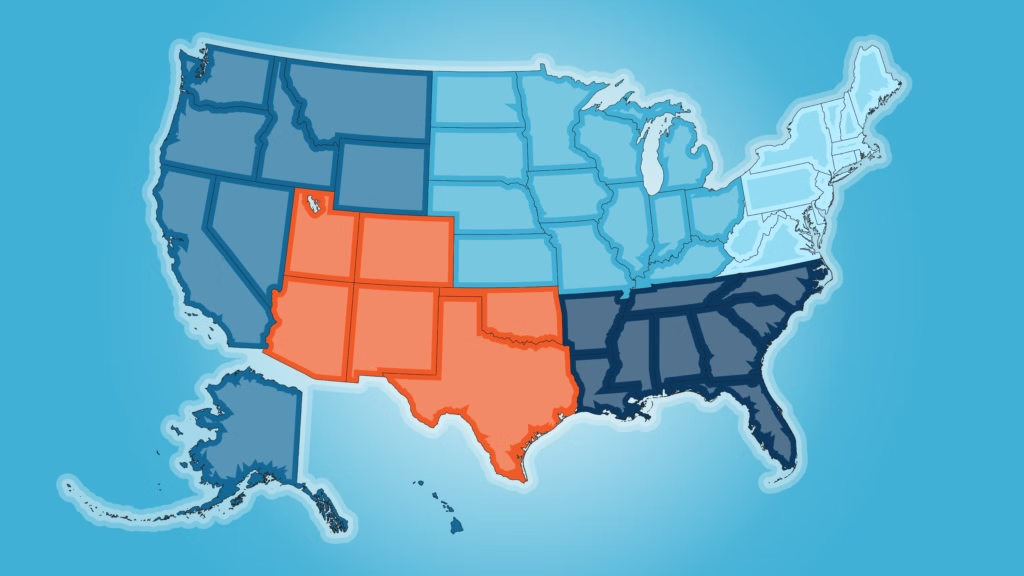
Here’s what to know about working in different regions of the country. Keep in mind salaries vary by state/metropolitan area and are based on the most recent salary guides available:

Northeast: High salaries and world-class healthcare facilities

Average RN salary: Approximately $100,000–$115,000 annually

The Northeast is home to some of the nation’s leading academic medical centers and teaching hospitals. Nurses often find opportunities in specialties such as:

Critical Care (ICU)

Emergency Nursing

Oncology

Cardiac Care

Neonatal ICU (NICU)

Cities like Boston and New York City may have a higher cost of living, but they also tend to offer higher wages and opportunities for career advancement. If you’re looking for more affordability but still want the New England lifestyle, consider cities like Burlington, VT, Lebanon, NH and Bangor, ME. You’ll find charming coastal towns, historic cities and easy access to scenic destinations like Acadia National Park, the Adirondacks, and the White Mountains.

Southeast: affordable living and rapid growth

Average RN salary: Approximately $78,000–$92,000 annually

The Southeast has more than a friendly culture and warm weather. States in the southeast continue to experience significant population growth, creating demand for healthcare professionals across hospitals, outpatient clinics, and long-term care facilities.

Popular specialties include:

Medical-Surgical Nursing

Labor & Delivery

Pediatrics

Home Health

Rehabilitation

Many nurses appreciate the region’s relatively affordable housing, warm climate, and access to beaches, mountains, and vibrant cities like Atlanta, Nashville, and Charlotte. Outside of these large cities, there are solid healthcare opportunities in affordable cities like Birmingham, AL, Columbus, GA, and Knoxville, TN. These growing cities have lots to do and vibrant culture for arts and music.

Midwest: A good balance between pay and cost of living

Average RN salary: Approximately $82,000–$96,000 annually

The Midwest has a lot to offer and affordability is one of its best value propositions. While salaries may be slightly lower than coastal markets, housing costs are generally much more affordable. Plus, with growing and diverse cities like Madison, WI, Omaha, NE, and Columbus, OH, you’re close to major airports and have a lot to do in each area. From outdoor activities like hiking and skiing to living in local downtown communities where dining and nightlife are within reach.

Growing specialties include:

Surgical Nursing

Orthopedics

Behavioral Health

Telemetry

Intensive Care

The Midwest is home to some of the country’s largest healthcare systems, as well as smaller, independent hospitals and facilities where you can strengthen your skills as a nurse.

word image 446482 1

Southwest: A hot job market that continues to heat up

Average RN salary: Approximately $88,000–$105,000 annually

For the last twenty years, states such as Arizona, Nevada, New Mexico, and Texas have continued to add hundreds of thousands of residents, increasing demand for healthcare workers across nearly every specialty.

Common areas of need include:

Emergency Medicine

Trauma

Operating Room (OR)

Progressive Care (PCU)

Case Management

Beyond work, the Southwest offers year-round sunshine, national parks including the Grand Canyon, desert landscapes, and vibrant cultural experiences. Additionally, cities like Phoenix, AZ, Dallas, TX and Salt Lake City, UT attract millions of new residents annually due to their booming job markets, unique culinary scenes and rich cultural heritage.

word image 446482 2

West/Northwest: high demand and endless adventure

Average RN salary: often exceeds $120,000 annually in many major cities

The West Coast consistently ranks among the country’s highest-paying regions for nurses. Many employers also offer competitive benefits, professional development, and opportunities to work with cutting-edge technology.

High-demand specialties include:

Operating Room

Cardiovascular ICU

Labor & Delivery

Oncology

Informatics

Although housing costs can be higher, many nurses are drawn to the beautiful Pacific coast, with its beaches and mountainous terrain. Plus, you can enjoy outdoor activities in national parks such as Yosemite and Olympic, which are accessible from cities like San Francisco and San Diego in California to Olympia and Seattle in Washington.

The best nursing jobs don’t stay open for long

The most desirable positions like those with competitive pay, flexible schedules, excellent benefits, or sought-after locations often receive applications quickly. Keeping your resume updated, maintaining current certifications and responding promptly to recruiters can help you stay ahead of the competition when the right opportunity becomes available.

Remember that every region of the country offers something unique. You might prioritize higher pay, a lower cost of living, professional growth, or the chance to experience a new part of the United States. Whatever your career goals are as a nurse, with demand remaining strong and opportunities available across every region and specialty, there’s never been a better time to explore where your next healthcare career could take you.

Kelsey Moena

Kelsey Moena

Healthcare organizations face some of the toughest workforce challenges: tight budgets, lean IT teams and limited tools for sourcing, hiring and onboarding staff. Add in manual scheduling, rising labor costs and high burnout, and the pressure grows. Rolling out complex systems can feel out of reach without dedicated tech support. Even simply evaluating new technology can overwhelm already stretched-thin teams.

These challenges make it clear that technology isn’t just helpful; it’s essential for healthcare organizations. Especially when they’re striving to do more with less. Not only are healthcare organizations falling short on implementing new technology, but they’re struggling to update outdated systems. A 2023 CHIME survey found that nearly 60% of hospitals use core IT systems, such as EHRs and workforce platforms, that are over a decade old. Outdated tools can’t integrate or scale, creating barriers to smarter staffing strategies. But the opportunity to modernize is real and urgent.

Tech in Patient Care Falls Short

In healthcare, technology has historically focused on clinical and patient care. Workforce management tools have taken a back seat to updating patient care systems. Yet many big tech companies have failed when it comes to customizing healthcare infrastructure and connecting patients with providers. Google Health shuttered after only three years, and Amazon’s Haven Health was intended to disrupt healthcare and health insurance but disbanded three years later.

Why the failures? It’s estimated that nearly 80% of patient data technology systems must use to create alignment is unstructured and trapped in data silos. Integration issues naturally form when there’s a lack of cohesive data that systems can share and use. Privacy considerations surrounding patient data are a challenge, as well. Across the healthcare continuum, federal and state healthcare data laws hinder how seamlessly technology can integrate with existing systems.

Why Smarter Staffing Is Now Essential

These data and integration challenges also hinder a healthcare organization’s ability to hire and deploy staff, an urgent healthcare priority. The U.S. will face a shortfall of over 3.2 million healthcare workers by 2026. At the same time, aging populations and rising chronic conditions are straining teams already stretched thin.

Smart workforce technology is becoming not just helpful, but essential. It allows organizations to move from reactive staffing to proactive workforce planning that can adapt to real-world care demands.

Global Inspiration: Japan’s AI-Driven Workforce Model

Healthcare staffing shortages aren’t just a U.S. problem. So, how are other countries addressing this issue? Countries like Japan are demonstrating what’s possible when technology is utilized not just to supplement staff, but to transform the entire workforce model. With one of the world’s oldest populations and a significant clinician shortage, Japan has adopted a proactive approach through its Healthcare AI and Robotics Center, where several institutions like Waseda University and Tokyo’s Cancer Institute Hospital are focusing on developing AI-powered hospitals.

Japan’s focus on integrating predictive analytics, robotics and data-driven scheduling across elder care and hospital systems is a response to its aging population and workforce shortages. From robotic assistants to AI-supported shift planning, Japan’s futuristic model proves that holistic tech integration, not piecemeal upgrades, creates sustainable staffing frameworks.

Rather than treating workforce tech as an IT patch for broken systems, Japan’s approach embeds these tools throughout care operations, supporting scheduling, monitoring, compliance and even direct caregiving tasks. U.S. health systems can draw critical lessons here: strategic investment in integrated platforms builds resilience, especially in a labor-constrained future.

The Power of Smart Workforce Technology

In the U.S., workforce management is becoming increasingly seen as more than a back-office function; it’s a strategic business operation directly impacting clinical outcomes and patient satisfaction. Smart technology tools are designed to improve care quality, staff satisfaction, scheduling, pay rates, compliance and much more.

For example, by using historical data, patient acuity, seasonal trends and other data points, organizations can predict their staff needs more accurately. The result is fewer gaps in scheduling, fewer overtime payouts and a flexible schedule for staff. AI-powered analytics can help healthcare leadership teams spot patterns in absenteeism, see productivity and forecast needs in multiple clinical areas in real-time. Workforce management tools can help plan scheduling proactively, rather than reactively. It’s a proven technology tool that can help drive efficiency and reduce costs.

Why So Many Are Still Behind

Despite the clear benefits, many healthcare organizations are slow to adopt smart tools that empower their workforce. Several things are holding them back from going all-in on technology:

Financial Pressures

Over half of U.S. hospitals are operating at or below break-even margins. For them, investing in new technology solutions is financially unfeasible. Scalable, subscription-based and even free workforce management tools are available, but most organizations are unaware of or lack the resources to source these products. Workforce management tools can deliver long-term return on investment for most organizations. Taking the time to understand where the value lies and which tools to invest in needs to happen.

Outdated Core Systems

Many facilities still depend on legacy technology infrastructure that lacks real-time capabilities. Many large players in the healthcare workforce management industry dominate hospital systems. Other smaller, real-time tools that offer innovative solutions to scheduling, workforce hiring, rate calculators and more are available at a fraction of the cost.

Competing Priorities and Strategic Blind Spots

Healthcare organizations and hospitals have many high-priority business objectives and regulatory demands. Digital transformation naturally falls down on the priority list, which causes them to miss improvements that can lead to long-term stability. With patient care and provider satisfaction at the top of the priority mountain, technology changes can be easily missed or shoved to the side when other business objectives are perceived to “move the needle” more.

Poor Change Management

Even the best technology efforts can fail without the right strategy for adoption and support from senior leadership. Resistance from staff, lack of training, or poor rollout communication can undermine success. Effective change management—clear leadership, role-based training and feedback loops—is essential.

Faster than the speed of technology

Change needs to come quickly to healthcare organizations in terms of managing their workforce efficiently. Smart technologies like predictive analytics, AI-assisted scheduling and mobile platforms will define this next era. These tools don’t just optimize operations but empower workers and elevate care quality.

Slow technology adoption continues to hold back the full potential of the healthcare ecosystem. Japan again offers a clear example: they had one of the slowest adoption rates of remote workers (19% of companies offered remote work) in 2019. Within just three weeks of the crisis, their remote work population doubled (49%), proving that technological transformation can happen fast when urgency strikes. The lesson is clear: healthcare organizations need to modernize faster for the sake of their workforce and the patients who rely on providers to deliver care.


Share On

Facebook
LinkedIn
WhatsApp
X
Email

Check out StaffDNA Insights